
We’ve come to the end of one year, to shorter days and longer nights, to times of reflection on the year behind and pondering what the new year will hold. As we look to a new year, there can be excitement for the future, but also dread over what the future may hold. Maybe you’re worried about your financial future, fearful about the unrest in culture and the widening divide between those who desire to lift high the name of Christ in culture and those who want Christians to stay silent. Maybe you’re feeling discouraged because you’re not where you thought you would be at this point in your life. I’ve felt all of these things.
I know the world can feel crazy right now, and if we look to the world around us for our reason to have hope, we will quickly be disappointed. But as believers, I want us to stay encouraged, because I truly believe there is reason to have hope in 2026. And that reason is this:
Jesus is King of kings and Lord of lords. His kingdom is here, He is reigning now, and He will have dominion! Because of Jesus, we can have hope for the future.
In Matthew 13, Jesus teaches a series of parables about the kingdom of heaven. Often when we hear about the kingdom of heaven, we think about spending eternity with Christ, but when Jesus talked about the kingdom of heaven in the gospels, He frequently said it was “at hand” (Matt. 3:2, 4:17, 10:7). The Greek word for “at hand” is engizō, which means “to draw or come near, to approach.”1 This is a perfect indicative verb, meaning it is a once for all action that is a statement of fact. The kingdom of heaven was about to show up, and when it showed up, it would be here to stay.
So, when did the kingdom of heaven show up? Jesus answered this question when the pharisees accused Him of casting out demons by the power of the devil.
Then a demon-possessed man who was blind and mute was brought to Jesus, and He healed him, so that the mute man spoke and saw. All the crowds were amazed, and were saying, “This man cannot be the Son of David, can he?” But when the Pharisees heard this, they said, “This man casts out demons only by Beelzebul the ruler of the demons.” And knowing their thoughts Jesus said to them, “Any kingdom divided against itself is laid waste; and any city or house divided against itself will not stand. If Satan casts out Satan, he is divided against himself; how then will his kingdom stand? If I by Beelzebul cast out demons, by whom do your sons cast them out? For this reason they will be your judges. But if I cast out demons by the Spirit of God, then the kingdom of God has come upon you. Or how can anyone enter the strong man’s house and carry off his property, unless he first binds the strong man? And then he will plunder his house. Matthew 12:22-29 (NASB95)
Jesus gives an if-then statement about the kingdom of God. Was Jesus casting out demons by the Spirit of God? Absolutely! So that means that the kingdom of God had come upon them. Through Jesus, the kingdom of God came down to earth, and His kingdom is here to stay. Jesus is reigning and ruling now, seated at the right hand of the Father. All the world belongs to Jesus, and His dominion will continue to grow until the knowledge of His glory covers the whole earth (Hab. 2:14).
Back to Matthew 13. Jesus shares multiple parables about the kingdom of heaven. First, He teaches the parable of the sower. He teaches about the spread of the word of the kingdom and the different responses of individuals who hear the good news. Some do not understand the good news. Others accept it “with joy,” but it doesn’t grow deep and they fall away the moment hardship shows up (Matt. 13:20-21). Others are unfruitful because they are consumed by the worries of the world. But those who hear and understand the word bear much fruit.
The next parable is the tares among the wheat. Again a man is sowing, this time good seed in a field. And in the middle of the night an enemy came and sowed tares, or weeds that look a lot like wheat, in his field.
But when the wheat sprouted and bore grain, then the tares became evident also. The slaves of the landowner came and said to him, ‘Sir, did you not sow good seed in your field? How then does it have tares?’ And he said to them, ‘An enemy has done this!’ The slaves *said to him, ‘Do you want us, then, to go and gather them up?’ But he *said, ‘No; for while you are gathering up the tares, you may uproot the wheat with them. Allow both to grow together until the harvest; and in the time of the harvest I will say to the reapers, “First gather up the tares and bind them in bundles to burn them up; but gather the wheat into my barn.”’” Matthew 13:26-30
Later, Christ explains the parable to His disciples. He tells them that He is the sower, that the field is the world, and the good seed “are the sons of the kingdom” (Matt. 13:37-38). The tares, on the other hand, are the “sons of the evil one” and the enemy is the devil (Matt. 13:38-39). The harvest is the end of the age, the final judgement where those who did not follow Christ will be cast into hell, while “the righteous will shine forth as the sun in the kingdom of their Father” (Matt. 13:43). Notice that the field is not a tares field with some wheat sprinkled in. Again, this parable is a reminder that the world belongs to Christ, and He will have a great harvest at the end of the age. That is a reason for hope!
(Do note that some theologians see this wheat field as referring to the whole world while others see it as referring only to the visible church on earth. This is often interpreted based on someone’s eschatology, or beliefs about end times. Personally, I believe the field refers to the world and not just the church because when Jesus explains the parable in verse 38, He says the field is the world.)
Jesus then tells the parable of the mustard seed, a small seed that grows into a big tree, and the parable of the leaven, where a small amount of leaven causes all the flour to become leavened. The gospel started small; a few hundred people followed Christ and were devoted to Him when the church began. But then the church began to grow, starting with the day of Pentecost, and it has continued to grow for the past two thousand years! His kingdom is growing, and that is a reason for hope.
Jesus then tells the parables of the hidden treasure and the costly pearl, both telling of a man who finds something of great value and sells all that he has to get that treasure. These parables can be interpreted in two different ways. The first is the picture of someone hearing the gospel and fully embracing it. The second is of God choosing us as His treasure. The Father gave us everything, through the death of Christ, in order to make us His. We are His chosen treasure, even though we are unworthy sinners, and that is a beautiful reason for hope.
The last parable Jesus told was of the dragnet, where fishermen caught a bunch of fish and gathered the good fish and thew away the bad. Jesus said that at the end of the age, just as He described in the parable of the tares, the wicked will be removed from among the righteous and thrown into hell, while the righteous will spend eternity with the Lord. Another reason for hope that we see in Matthew 13 is that one day we will all experience the justice of God, either as those who rejected Christ and will experience His wrath, or as those who were bought by the blood of Christ – Christ who took God’s wrath upon Himself in our place so that when God sees us, He sees the righteousness of Christ.
There is much reason for hope. Jesus is reigning and ruling now. His kingdom is expanding and will continue to expand until He returns. Because of Christ, we can be counted as righteous before God. Jesus wins! And because of Jesus we can have hope for the new year.
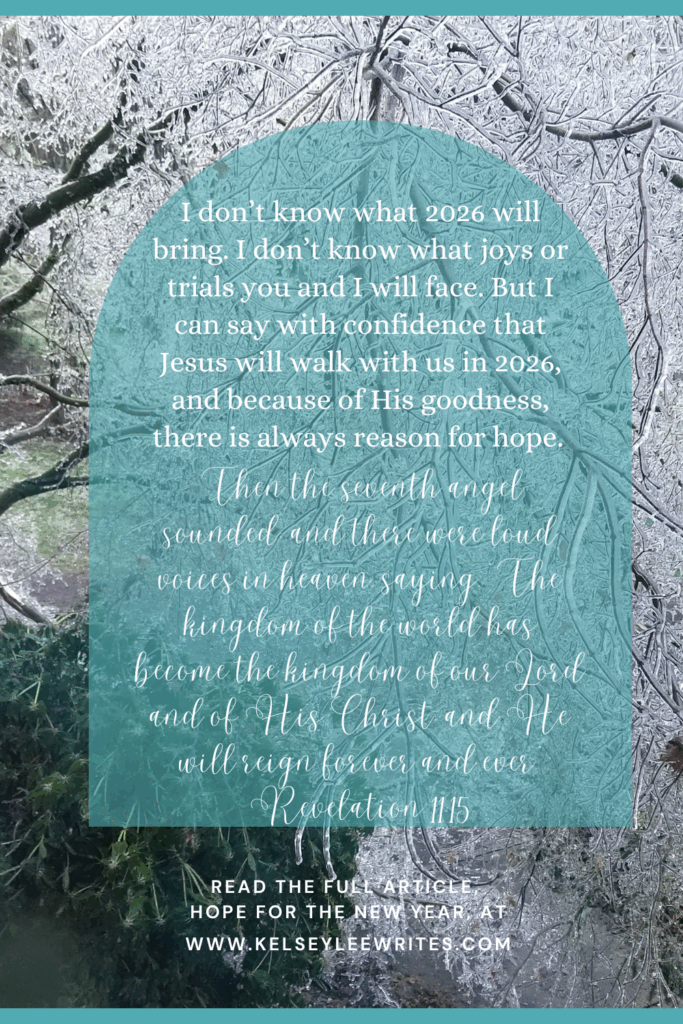
I don’t know what 2026 will bring. I don’t know what joys or trials you and I will face. But I can say with confidence that Jesus will walk with us in 2026, and because of His goodness, there is always reason for hope.
Then the seventh angel sounded; and there were loud voices in heaven, saying, “The kingdom of the world has become the kingdom of our Lord and of His Christ; and He will reign forever and ever.” Revelation 11:15
With love,
Kelsey
P.S. We talk about 10 reasons for hope on today’s podcast episode! Listen here: https://www.podbean.com/eas/pb-r3qnn-19ca400
- “G1448 – engizō – Strong’s Greek Lexicon (nasb95).” Blue Letter Bible. Web. 26 Nov, 2025. <https://www.blueletterbible.org/lexicon/g1448/nasb95/mgnt/0-1/>. ↩︎






2 comments
Julie
Jesus truly is our hope! Praise God for sending His Son so we can have hope!
Kelsey
Amen!
Comments are closed.